InfinitySPM

Revenue Performance Management for the CFO: Bridging Finance and Go-To-Market

The mandate for the modern Chief Financial Officer has fundamentally changed. Today’s finance leaders are no longer just custodians of the balance sheet; they are expected to act as strategic architects of the company’s go-to-market (GTM) execution. They are tasked with driving efficient growth, protecting margins, and ensuring absolute accountability across the enterprise.

However, a massive structural hurdle frequently prevents finance teams from executing this mandate: The Revenue Blind Spot. When financial planning, sales territory design, and incentive compensation operate in isolated systems, the link between corporate strategy and field execution breaks. For CFOs, VPs of Finance, and FP&A leaders, Revenue Performance Management (RPM) represents the operational bridge needed to close this gap. It replaces fragmented data with a unified, finance-grade operating model that aligns the boardroom with the sales floor. Here is why RPM is the most critical strategic lever for modern finance teams, and how it transforms overarching financial targets into governed, actionable sales execution.

The Core Conflict: Two Different Revenue Realities

The most immediate symptom of a disconnected revenue organization is the “Competing Truths” dilemma. If you ask the CFO and the Chief Revenue Officer (CRO) for the current revenue projection on the same day, you will often receive two entirely different answers. The frustrating reality is that both numbers are technically defensible. The CRO’s number is based on real-time CRM data, pipeline coverage, and subjective seller sentiment. The CFO’s number is grounded in the Annual Operating Plan (AOP), historical run rates, and rigorous financial assumptions. Because these two leaders rely on different systems, different timing, and different baseline data, they cannot form a unified view of what is happening or why. This fragmentation creates a profound business risk. When Finance and Sales cannot agree on the baseline facts, GTM models become rigid. The business struggles to adjust coverage, quotas, or incentives fast enough when new market signals emerge or performance inevitably drifts from the plan.

The Financial Pain of Disconnected Revenue Operations

For the Office of Finance, the symptoms of the Revenue Blind Spot translate into severe operational and financial pain.

01

Shadow Accounting and Audit Risk

When sales compensation and quota management are handled in spreadsheets or isolated legacy tools, data inevitably degrades. Compensation administrators and Sales Ops teams are forced into manual reconciliations and shadow accounting just to calculate payouts. This manual intervention creates intense operational drag, elevates the risk of costly commission errors, and introduces significant audit and compliance risks for the Controller.

02

Blind Spots in Margin and Cost of Sales

CFOs are accountable for cost discipline, but they often lack visibility into the specific commercial levers driving those costs. If incentive logic and crediting rules sit entirely outside the corporate revenue model, finance cannot accurately simulate or stress-test commission plans. This leads to unpredictable commission leakage, budget overruns, and a fundamental inability to evaluate how execution choices are impacting gross margins.

03

The AI and Analytics Data Trap

Boards and executive teams are eager to deploy artificial intelligence to predict revenue outcomes and optimize sales behavior. However, AI cannot run on fragmented systems and weak CRM inputs. If the underlying data is a patchwork of siloed assumptions, AI will simply amplify those inconsistencies. Finance needs a governed, trusted data foundation before predictive analytics can provide any real value.

How RPM Bridges the Gap Between FP&A and Sales

Revenue Performance Management solves these financial pains by establishing a single, unified operating cycle. It ensures that planning, execution, incentives, and insights all run on the same governed data model.
Unifying the Annual Operating Plan (AOP) with Sales Capacity

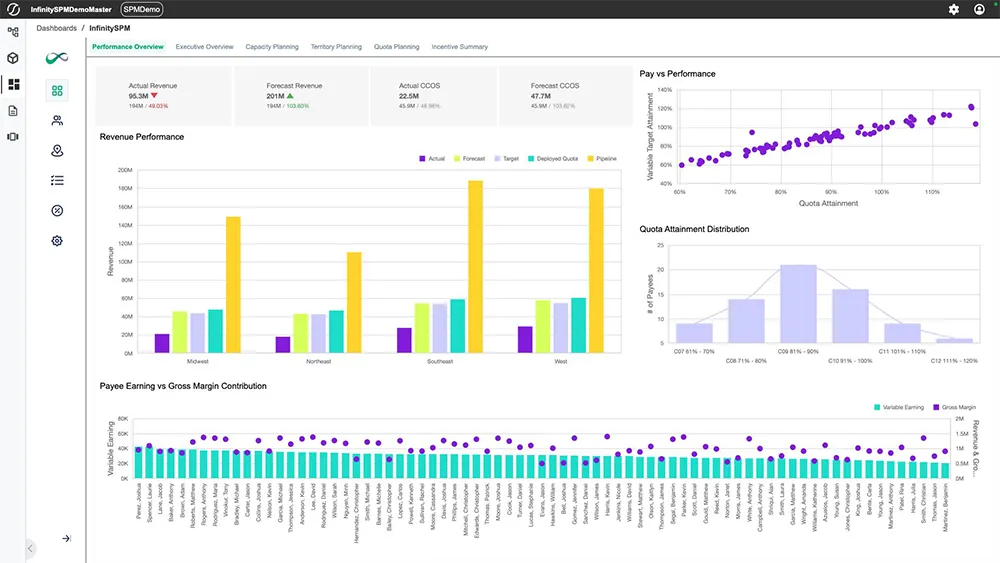
The traditional handoff between Finance and Sales is often where the plan falls apart. Finance builds the AOP, hands a top-line target to Sales, and hopes the execution model can support it. RPM integrates the financial AOP process directly with sales-led targets, capacity planning, and incentive design on a single platform. This means revenue plans are built collaboratively. Finance-guided models are enriched with actual sales capacity realities, ensuring that the final commitments are aligned, realistic, and fully executable.

Translating Sales Coverage into Financial Impact

Under an RPM framework, Finance and Sales evaluate trade-offs using the exact same scenarios, drivers, and constraints. When Sales leadership wants to adjust account segmentation or alter territory coverage, RPM instantly translates those GTM decisions into projected financial impacts. This shared visibility allows the business to surface revenue risks, spot coverage gaps, and identify costly incentive impacts early enough to take corrective action.

Establishing Finance-Grade Controls Over Execution

By linking the AOP directly to territories, quotas, and commissions, RPM introduces unprecedented governance to the sales floor.

The Urgency for Finance Transformation

Why is the shift to RPM becoming an immediate priority for finance leaders? The urgency is typically triggered by key operational events where legacy tools simply break down under the pressure of enterprise scale. Key Triggers for RPM Adoption:

Leading the Revenue Ecosystem

The CFO can no longer afford to operate with a Revenue Blind Spot. Relying on disconnected corporate planning tools, isolated incentive calculators, and unverified CRM data leaves the business vulnerable to margin erosion and execution failure. By championing Revenue Performance Management, finance leaders can unify planning, optimize incentive spend, and finally establish a single source of truth across the entire enterprise. It is the definitive step required to transform the Office of Finance from a reporting function into the strategic engine driving intentional, disciplined, and profitable revenue growth.

Drive Revenue. Align Teams. Succeed with SPM on OneStream

Get in touch today to unlock the full potential of your sales performance management with the infinitySPM Solution.