InfinitySPM

The Ultimate Guide to Revenue Performance Management (RPM)

For modern mid-market and enterprise organizations, driving efficient growth is no longer just about hiring more sales representatives or adjusting quotas. Executive teams face immense pressure to protect profitability, ensure accountability across all departments, and adapt their go-to-market (GTM) strategies the moment conditions change.
However, a fundamental disconnect often stands in the way. Organizations frequently try to manage complex revenue models, multiple sales roles, and variable compensation using disconnected systems. This creates a severe gap between the financial targets established in the boardroom and the actual sales execution happening in the field. Closing this gap requires a structural evolution. It requires moving beyond isolated sales performance tools and adopting a holistic operating cycle known as Revenue Performance Management.

What is Revenue Performance Management (RPM)?

Revenue Performance Management (RPM) is the unified operating model that connects corporate revenue planning, territory and quota management (TQM), incentive compensation management (ICM), and revenue analytics into a single, governed ecosystem. Instead of treating the revenue lifecycle as a series of sequential, siloed tasks, RPM ensures that financial planning, sales execution, and incentive logic all run on the same data foundation. This allows organizations to tie commercial decisions directly to business outcomes, ensuring that finance and sales operate from a single source of truth.

RPM vs. SPM vs. Corporate Performance Management

The market has historically approached revenue through fragmented categories.

Legacy Sales Performance Management (SPM)

Traditional SPM vendors focus heavily on administering incentive compensation. While necessary, these tools often lack deep workflow capabilities and fail to link payout data back to the broader corporate revenue model.

Corporate Performance Management (CPM)

CPM platforms are excellent at modeling financial targets. However, when organizations attempt to extend those targets into the granular details of territory management or incentive compensation, the process becomes highly customized, bespoke, and administratively heavy.

RPM bridges these two worlds, reducing the administrative burden while maintaining finance-grade governance.
The Core Problem: The "Revenue Blind Spot"

RPM directly addresses one of the most pervasive challenges in modern business: the Revenue Blind Spot. This blind spot occurs when revenue planning, territory assignments, incentive logic, and analytics are managed across entirely separate workflows, spreadsheets, and databases. Leaders may have visibility into isolated fragments of performance, but they lack a unified, governed view of what is actually happening, why it is occurring, and how to course-correct.

Competing Truths: The CFO vs. CRO Dilemma

The most glaring symptom of the Revenue Blind Spot is the reporting disconnect between departments. If you ask the Chief Financial Officer and the Chief Revenue Officer for the current revenue figures on the exact same day, you will frequently receive two different numbers. Both numbers are usually defensible. However, they are built on entirely different timing, assumptions, and data sources. This fragmentation prevents leadership from understanding the full picture. It severely hinders an organization’s ability to grow efficiently, safeguard margins, and confidently pivot strategy when market dynamics shift.

The AI Data Trap

The Revenue Blind Spot also presents a critical threat to modernization. Executive teams are eager to leverage artificial intelligence to gain predictive insights, but AI requires a foundation of trusted, governed data. If an organization’s revenue data is scattered across weak CRM entries, siloed assumptions, and fragmented spreadsheets, AI cannot succeed. Instead of delivering sharp, strategic insights, AI will simply amplify the existing inconsistencies. RPM establishes the trusted data foundation required for AI to actually improve decision-making rather than muddying the waters.

Who Suffers from Disconnected Revenue Operations?

The urgency to solve the Revenue Blind Spot spans across the entire executive suite and operational layers of an enterprise.
Finance leaders carry the ultimate accountability for revenue accuracy, business performance, and cost discipline. Yet, they are routinely forced to manage these outcomes without adequate visibility into the commercial levers that shape them. They experience deep financial pain through manual data reconciliation, shadow accounting practices, and fragmented controls that introduce significant audit risk. They struggle to evaluate revenue decisions because the cost of sales, margin impacts, and commission expenses are not modeled alongside execution choices.

The CRO and Sales Leadership

The CRO requires absolute confidence that the organization’s territories, quotas, coverage models, and incentive designs are actively driving the behaviors needed to achieve committed growth. Under the current fragmented state, GTM strategies are incredibly difficult to optimize. When new market signals emerge, capacity and coverage decisions cannot be adjusted with the necessary speed, making it nearly impossible to protect the revenue pipeline.

RevOps, Sales Ops, and Compensation Administrators

For the operational teams aligned to finance and sales, the pain is deeply personal and daily. They are buried under fragmented workflows and manual fixes. Controllers and compensation administrators operate under intense pressure to deliver accurate, easily explainable payouts, yet they are forced to do so in environments with incredibly limited room for error and weak systemic controls.

The Symptoms of a Broken Revenue Lifecycle

When planning, execution, and incentives live in separate systems, the business suffers from clear, operational symptoms:

The 4 Pillars of the RPM Operating Cycle

True Revenue Performance Management moves an organization from isolated planning to a complete, continuous operating cycle. This cycle is built on four core capabilities that share the same governed assumptions and business rules.

Unified Revenue Planning

The foundation of RPM begins with aligning the financial Annual Operating Plan (AOP) with sales-led targets.

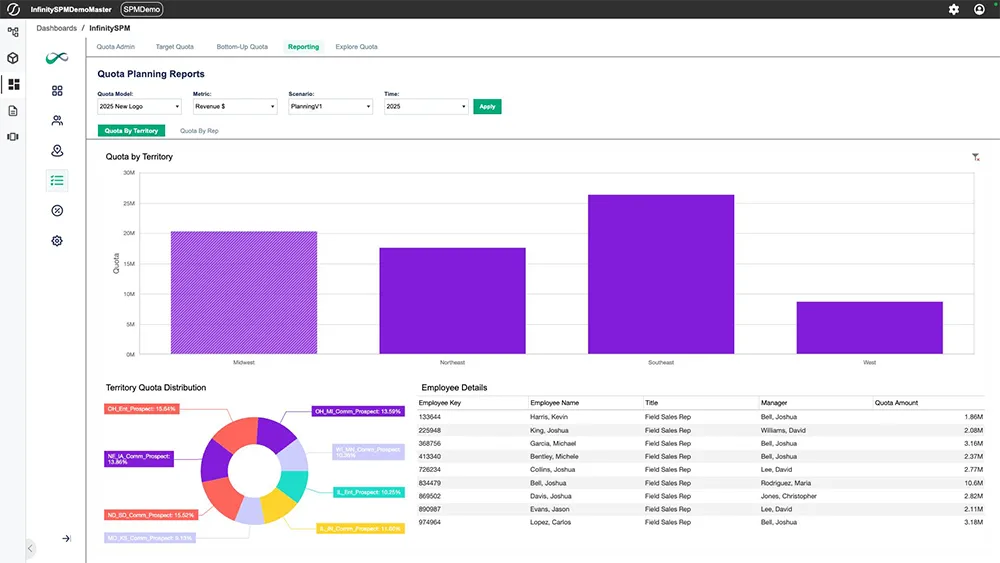
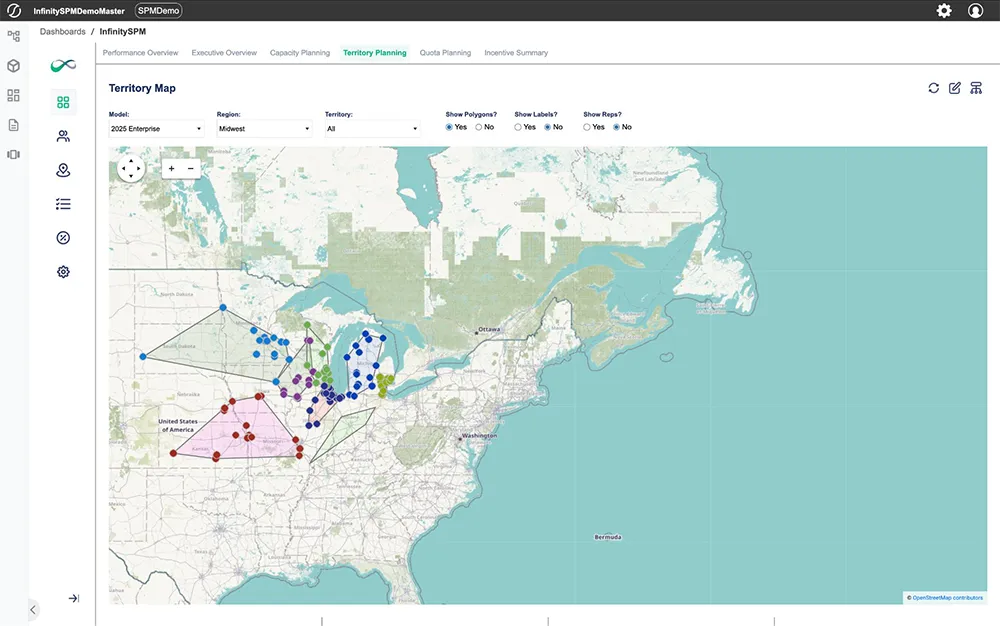
Revenue Excellence through Territory and Quota Management

Once the plan is established, it must be translated into an actionable field execution model. This is the core of modern Sales Performance Management. (To dive deeper into the mechanics of SPM, read our CFO’s Guide to Sales Performance Management).

Optimized Incentive Compensation Management

Incentives are the engine that drives execution. Under RPM, compensation is not a standalone administrative task; it is deeply linked to the planning model. (Learn more about setting up these structures in our Intro to Incentive Compensation Management).

Revenue Insights and AI

The final pillar closes the loop by refreshing the model with ongoing visibility, replacing CRM noise with trusted, actionable intelligence.

RPM: Essentials vs. Differentiators

As organizations evaluate how to fix their revenue operations, it is vital to distinguish between basic table stakes and true RPM capabilities.
The Essentials (Table Stakes)

The Differentiators (True RPM)

Triggers for Change: When is it Time for RPM?

Organizations typically realize they have outgrown their fragmented systems and need a unified RPM approach when they hit specific operational friction points. The most common urgency triggers include:

Bridging the Gap

The transition to Revenue Performance Management represents a fundamental shift in how enterprise and mid-market businesses operate. It is not simply about upgrading a commission calculator or deploying a new quota-setting spreadsheet. It is about fundamentally tying commercial decisions to business outcomes with unwavering rigor, visibility, and mutual accountability, in a unified way across the organization.
By unifying planning, execution, incentives, and insights onto a single, governed platform, organizations can finally tear down the silos between Finance and Go-To-Market teams. Doing so not only removes the Revenue Blind Spot but establishes the trusted, clean data foundation required to lead in an AI-driven future.

Drive Revenue. Align Teams. Succeed with SPM on OneStream

Get in touch today to unlock the full potential of your sales performance management with the infinitySPM Solution.